Hunting Criminals with Hybrid Analytics, Semi-supervised Learning, & Feedback - Seguridad Mania.com - España y América Latina
Portal sobre tecnologías para la seguridad física
Estás en »Webinars
Estás en »Webinars
Miércoles 23 de Ago, 2017
Fraud detection is a classic adversarial analytics challenge: As soon as an automated system successfully learns to stop one scheme, fraudsters move on to attack another way. Each scheme requires looking for different signals (i.e. features) to catch; is relatively rare (one in millions for finance or e-commerce); and may take months to investigate a single case (in healthcare or tax, for example) – making quality training data scarce. This talk will cover a code walk-through, the key lessons learned while building such real-world software systems over the past few years. We'll look for fraud signals in public email datasets, using IPython and popular open-source libraries (scikit-learn, statsmodel, nltk, etc.) for data science and Apache Spark as the compute engine for scalable parallel processing. David will iteratively build a machine-learned hybrid model – combining features from different data sources and algorithmic approaches, to catch diverse aspects of suspect behavior: - Natural language processing: finding keywords in relevant context within unstructured text - Statistical NLP: sentiment analysis via supervised machine learning - Time series analysis: understanding daily/weekly cycles and changes in habitual behavior - Graph analysis: finding actions outside the usual or expected network of people - Heuristic rules: finding suspect actions based on past schemes or external datasets - Topic modeling: highlighting use of keywords outside an expected context - Anomaly detection: Fully unsupervised ranking of unusual behavior Apache Spark is used to run these models at scale – in batch mode for model training and with Spark Streaming for production use. We’ll discuss the data model, computation, and feedback workflows, as well as some tools and libraries built on top of the open-source components to enable faster experimentation, optimization, and productization of the models.
06:00 - 07:00 hs GMT+1
11:00 - 12:00 hs GMT+1
04:00 - 05:00 hs GMT+1
05:00 - 06:00 hs GMT+1
06:00 - 07:00 hs GMT+1
09:00 - 10:00 hs GMT+1
16:00 - 17:00 hs GMT+1
00:00 - 01:00 hs GMT+1
04:30 - 05:00 hs GMT+1
01:00 - 02:00 hs GMT+1
02:00 - 03:00 hs GMT+1
03:00 - 04:00 hs GMT+1
05:00 - 06:00 hs GMT+1
11:30 - 12:00 hs GMT+1
13:00 - 14:00 hs GMT+1
00:00 - 01:00 hs GMT+1
03:00 - 04:00 hs GMT+1
03:00 - 04:00 hs GMT+1
04:30 - 05:00 hs GMT+1
03:00 - 04:00 hs GMT+1
06:00 - 07:00 hs GMT+1
13:00 - 14:00 hs GMT+1
03:00 - 04:00 hs GMT+1
03:30 - 04:00 hs GMT+1
01:00 - 02:00 hs GMT+1
05:00 - 06:00 hs GMT+1
02:00 - 03:00 hs GMT+1
03:00 - 04:00 hs GMT+1
13:00 - 14:00 hs GMT+1
06:00 - 07:00 hs GMT+1
09:00 - 10:00 hs GMT+1
05:00 - 06:00 hs GMT+1
09:00 - 10:00 hs GMT+1
06:00 - 07:00 hs GMT+1
11:00 - 12:00 hs GMT+1
04:00 - 05:00 hs GMT+1
05:00 - 06:00 hs GMT+1
06:00 - 07:00 hs GMT+1
09:00 - 10:00 hs GMT+1
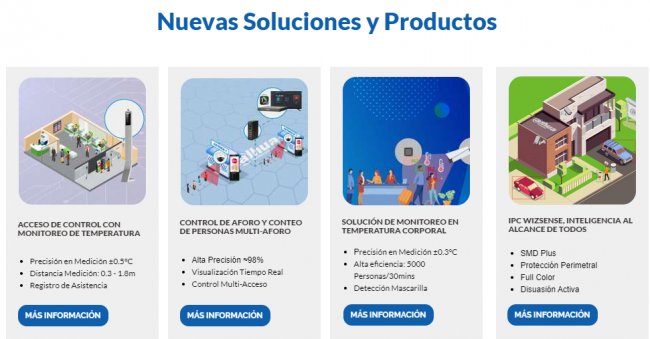
La Autoridad Portuaria de la Bahía de Algeciras (APBA) ha instalado cámaras térmicas en las zonas de mayor tránsito de pasajeros del puerto para controlar la temperatura corporal de los pasajeros sin necesidad de pararles. ... Leer más ►
Publicado el 2-Jul-2020 • 14.23hs
Publicado el 25-Ene-2017 • 19.27hs
Publicado el 20-Ene-2017 • 13.11hs
![Ciberseguridad en la gran empresa según el CIO de Vocento [Webinar de 6o min]](https://www.seguridadmania.com/img/articles/71622/vocento.png)
Publicamos grabación de webinar que tuvo lugar el pasado 28/03/2019 por el CIO del Grupo de Medios de Comunicación español Vocento Jorge Oteo en el que explica su visión de la Ciberseguridad hoy. ... Leer más ►
Publicado el 29-Mar-2019 • 10.12hs
Publicado el 20-Jun-2018 • 11.21hs
Publicado el 31-May-2018 • 10.21hs
... Leer más ►
Publicado el 23-Jun-2020 • 16.05hs
Publicado el 26-Set-2019 • 10.36hs
Publicado el 26-Mar-2019 • 12.09hs
Publicado el 11-Oct-2016 • 12.48hs
Publicado el 15-Mar-2016 • 11.59hs
Publicado el 2-Feb-2017 • 11.38hs
Publicado el 20-Jun-2014 • 17.17hs
Publicado el 31-May-2011 • 05.13hs
Publicado el 25-Set-2008 • 17.54hs
Publicado el 1-Set-2016 • 16.11hs
Publicado el 31-Ago-2016 • 18.53hs
Publicado el 19-Ene-2017 • 15.47hs
Publicado el 4-Jul-2016 • 18.51hs
 © 2001-2026 DAA Contenidos Digitales, S.L.


